July 15th, 2025, Court Leader’s Advantage Podcast Episode
Brought to You in Cooperation with the National Association for Court Management

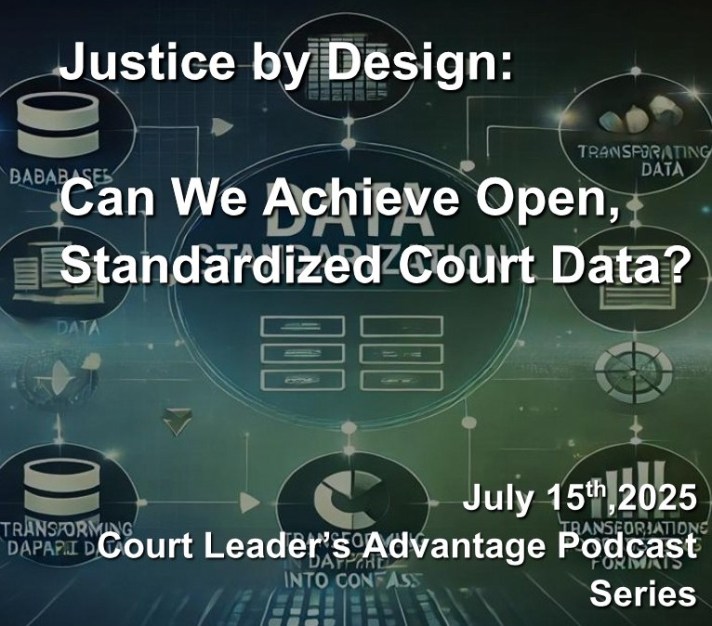
One of the major challenges facing state trial courts today is the disturbing lack of accurate national statistical data. Beneath the surface of our justice system lies a troubling truth: we often don’t know, we can’t know, what’s really happening.
How many cases do our courts handle? What kinds? How efficiently? Without reliable data, we are left to make educated guesses in the dark. This absence of clarity is not accidental, it is the result of a decentralized system of justice. Some of the results include:
Lack of Uniform Court Coding
What one court calls a “hearing,” another might call a “conference.” These differences seem small, but they add up to a patchwork of mismatched codes, formats, and definitions across jurisdictions.
Limited Data Transparency and Public Access
Even when data exists, it is often locked behind arcane systems, hard to find, and harder to interpret. Hurdles with Data Sharing
Disconnected technologies, legacy systems, and inconsistent standards create silos of information making collaboration truly a challenge.
Inability to Measure Performance and Outcomes
Without standardized metrics, we can’t track how long cases take, how they’re resolved, or whether justice is truly being served. It’s like trying to navigate with a map that constantly changes shape.
Addressing this challenge is the National Open Court Data Standards project (NODS). It is a collaborative effort led by the National Center for State Courts, the Conference of State Court Administrators, and the Joint Technology Committee. By creating shared standards for collecting, sharing, and interpreting court data, NODS shines a light in the shadows, allowing courts to operate with greater transparency, efficiency, and consistency.
This month, we are looking at the National Open Court Data Standards project. We explore how this effort will transform access to court data for researchers, policymakers, the media, and the public.
Listen to the July 15, 2025, CLA Podcast Episode on your way to or from work. 32 Minutes 14 Seconds. Be sure to share the link to this episode on your social media pages. It lets more people know about the important work of court administration in our community.
Watch the July 15, 2025, CLA Podcast Episode on YouTube. 33 Minutes 26 Seconds. Be sure to click on the subscribe button. It draws more attention to the topic of court administration on YouTube.
Become Part of the Conversation
Send in your comments and questions to CLAPodcast@namnet.org
Today’s Panel

Laura Ritenour is the Caseflow Management Specialist for the Arizona Administrative Office of the Courts (AOC) Court Services Division and coordinates the statewide case processing time standards and the Required Data Elements initiatives. Her career with the courts began as an Administrative Analyst in 2000 at Lane County Circuit Court (Eugene, Oregon).
She then moved to Arizona in 2008, where she began working at Scottsdale City Court. She was their Technology Coordinator for 4 years and then an Operational Supervisor for 4 years, leading the Public Service and Courtroom Operations teams. From 2016 to 2021, Laura worked as a Business Analyst for the Consolidated Collections Unit at the Arizona AOC. Her work focused on assisting courts joining the statewide collections program and coordinating training initiatives.
Laura received her Master of Legal Studies at the University of Arizona’s James E. Rogers College of Law in May 2023. She became an Institute for Court Management Certified Court Executive in February 2025. Laura holds a B.A. in Biology from the University of California at Santa Barbara and served as a US Peace Corps volunteer in Papua New Guinea (South Pacific) in 1997-1998.
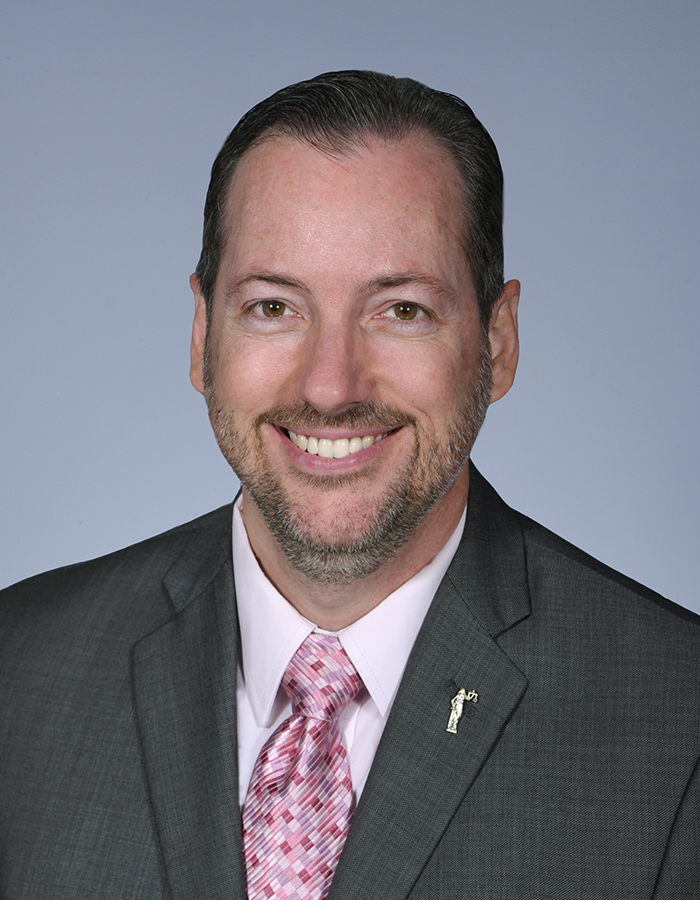
Tracy “T.J.” BeMent is the District Court Administrator for the 10th Judicial Administrative District of Georgia. The 10th JAD covers the general jurisdiction Superior courts in six circuits in 21 counties. He was previously the Court Administrator for the Athens-Clarke County Courts in Athens, Georgia, where he worked with all six levels of trial courts in the county. He acts as the primary liaison to the state and county governments and serves as a resource for the judges and judicial staff on many issues.
T.J. administers nearly $2 million in state and federal grants and is a federal grant peer reviewer. He has been working in the courts for more than 15 years. Prior to coming to Georgia, he was the Assistant Court Administrator for the Las Vegas Justice Court and previously the Clerk of Court and Chief Administrative Officer of the District of Columbia’s Office of Administrative Hearings. He received his undergraduate and graduate degrees from the George Washington University in Washington, DC, and completed his ICM Fellowship in spring 2015
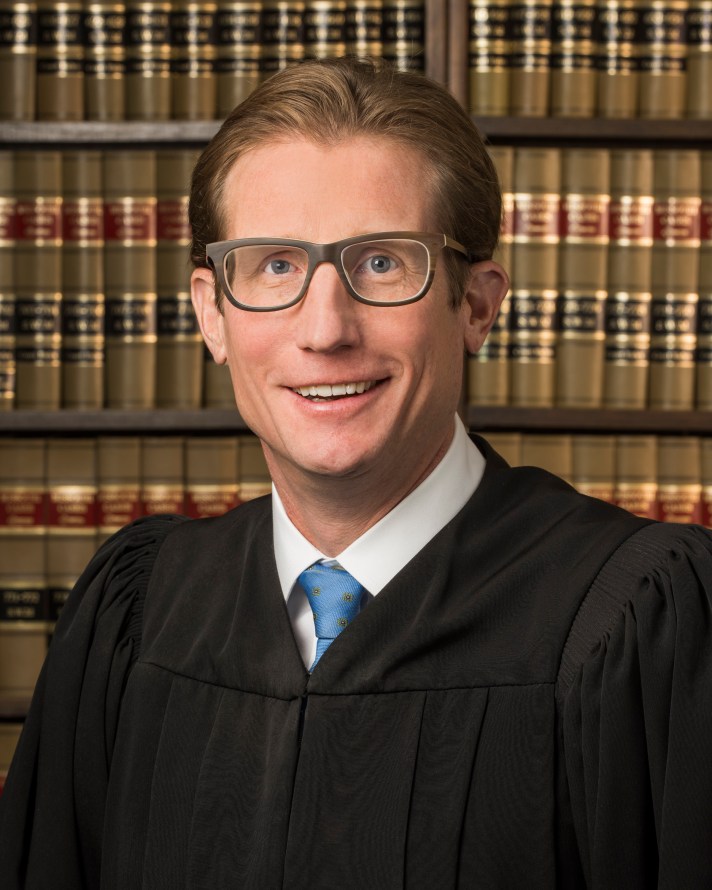
W. Brent Powell has recently been elected Chief Justice of the Supreme Court of Missouri. He is from Springfield, Missouri, and completed his undergraduate degree at William Jewell College in Liberty, Missouri. He received his J.D. from the University of Missouri-Columbia School of Law in 1996.
Following law school, Judge Powell began his legal career at Lathrop & Gage in Kansas City, Missouri. In the fall of 1997, he took a position as an Assistant Prosecutor in the Platte County Prosecutor’s Office in Platte City, Missouri. In 2001, he began working as an Assistant United States Attorney for the United States Attorney’s Office located in Kansas City, Missouri. During his tenure at the United States Attorney’s Office, he served as the Chief of the General Crimes Unit and Executive Assistant United States Attorney.
Judge Powell was appointed to the office of Circuit Court Judge by Governor Matt Blunt. He took the oath of office on February 15, 2008, and served as a Circuit Court Judge in Division 11 of the 16th Judicial Circuit in Jackson County, Missouri. As a Missouri Circuit Court Judge, he served on the Missouri Supreme Court Committee on Procedure in Criminal Cases, the Committee on Access to Family Courts, the Trial Judge Education Committee and the Missouri Sentencing Advisory Commission.
Judge Powell was appointed to the Missouri Supreme Court by Governor Eric Greitens on April 25, 2017. He took the oath of office on May 2, 2017. He was named “Judge of the Year” in 2009 by the Association of Women Lawyers of Greater Kansas City, and he received the Kansas City Metropolitan Bar Association President’s Award in 2014 for outstanding service to the Bar. He was recognized in 2022 by William Jewell College with the Citation of Achievement, the school’s highest alumni award, and in 2022, he was elected to the American Law Institute to bring his legal expertise in clarifying the law through Model Codes and Restatements.
Do You Want to Know More?
NODS for Domestic Violence Cases

 Court Leader