
Last November’s blog post explored the meaning of the Rule of Law.[i] That post presented four universal Rule of Law principles:
- Accountability -The government as well as private actors are accountable under the law.
- Just Law – The law is clear, publicized, and stable and is applied evenly. It ensures human rights as well as property, contract, and procedural rights.
- Open Government -The processes by which the law is adopted, administered, adjudicated, and enforced are accessible, fair, and efficient.
- Accessible and Impartial Justice -Justice is delivered timely by competent, ethical, and independent representatives and neutrals who are accessible, have adequate resources, and reflect the makeup of the communities they serve.
This blog post takes a deeper dive into the procedural rights noted in the “Just Law” bullet point above. Procedural rights are more commonly expressed in the term Due Process, a legal term often taken for granted. But current events in the United States (including comments made by the President)[i] have brought Due Process to the forefront of many high-profile legal cases and controversies. Every court leader needs to fully understand and apply Due Process in their work. Let’s explore what is meant by Due Process to help us understand these matters.
The United States Constitution has two “Due Process” related amendments:
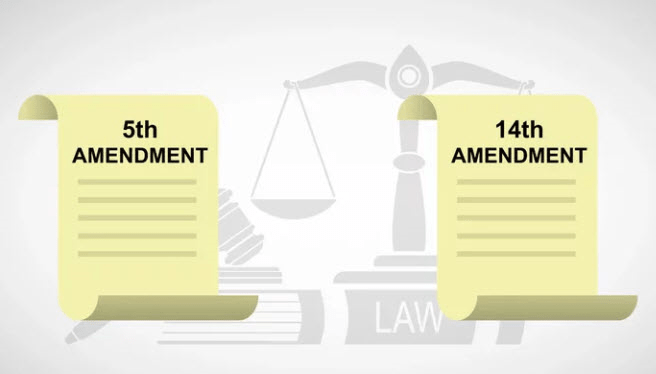
- The clause in the Fifth Amendment to the United States Constitution provides: “No person shall … be deprived of life, liberty, or property, without due process of law.”
- The clause in the Fourteenth Amendment to the United States Constitution provides: “…nor shall any State deprive any person of life, liberty, or property, without due process of law.”
The U.S. Supreme Court interprets these clauses to guarantee a variety of protections: procedural due process (in civil and criminal proceedings); substantive due process (a guarantee of some fundamental rights); a prohibition against vague laws; incorporation of the Bill of Rights to state governments; and equal protection under the laws of the federal government.[i]
The legal term “due process of law” is not a recent development, as it first appeared in a statutory rendition of the Magna Carta in 1354.
In this blog post I am highlighting “procedural due process” due to its direct applicability to judicial administration. The essence of procedural due process requires the government to follow fair procedures when depriving a person of life, liberty, or property.
But what are these procedures? In a 1975 law review article, Judge Henry Friendly generated a list that remains highly influential as to both content and relative priority:
- An unbiased tribunal.
- Notice of the proposed action and the grounds asserted for it.
- Opportunity to present reasons why the proposed action should not be taken.
- The right to present evidence, including the right to call witnesses.
- The right to know opposing evidence.
- The right to cross-examine adverse witnesses.
- A decision based exclusively on the evidence presented.
- Opportunity to be represented by counsel.
- Requirement that the tribunal prepare a record of the evidence presented.
- Requirement that the tribunal prepare written findings of fact and reasons for its decision.[i]
These rights apply to all government proceedings, civil or criminal, that can result in an individual’s deprivation of life, liberty, or property. In addition, “the Supreme Court has held that this protection extends to all natural persons (i.e., human beings), regardless of race, color, or citizenship.”[ii]
Court leaders need to understand and apply these ten Due Process procedures to effectively do their jobs across the breadth of court functions. I highly recommend the CORE®competencies of the National Association for Court Management for in-depth material on all of these functions, and in particular, the “Purposes and Responsibilities” area, which provides an excellent foundation for understanding the context of Due Process.[iii]
As noted at the start of this blog post, current events make it essential for court leaders to understand and support Due Process. I hope this post has helped to shed light on the subject and improve our dedication to the Rule of Law in our courts.
[ii] Yick Wo v. Hopkins, 118 U.S. 356 (1886); Terrace v. Thompson, 263 U.S. 197, 216 (1923). See Hellenic Lines v. Rhodetis, 398 U.S. 306, 309 (1970).
[iii] Purposes and Responsibilities – National Association for Court Management
[i] Due Process Clause – Wikipedia
[i] https://apnews.com/article/trump-due-process-canada-greenland-military-action-8da3e853b6cec944ec373fae4d317ac4
[i] Demystifying and Measuring the Rule of Law – Court Leader

 Court Leader
One thought on “What is meant by “Due Process?””