
The annual Rule of Law Index of the World Justice Project is now available [WJP Rule of Law Index (worldjusticeproject.org)].[i] Earlier this year I made a lengthy blog post outlining the importance of the Rule of Law, provided details about how the Rule of Law Index is calculated, and the 2022 findings (see The Rule of Law, Index, and You – Court Leader and ROLI = Rule of Law Initiative (not Index) – Court Leader. Now that the 2023 Index is out, an update is in order.
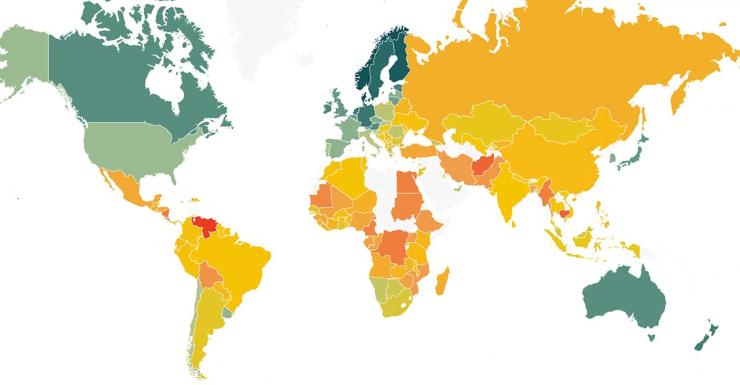
Unfortunately, the overall picture is not good. Here are some key findings:
- Between 2022 and 2023, the Rule of Law once again weakened in a majority of countries: 82 countries declined, 58 improved. Over six billion people live in a country where the Rule of Law is declining.
- In two out of three countries civil justice systems weakened last year. Between 2022 and 2023, civil justice scores around the world fell due to longer delays, weaker enforcement, and declining access and affordability.
- Human rights declined in 3 out of 4 countries since the global rule of law recession began in 2016.
- To see the countries ranked, go to WJP Rule of Law Index | Global Insights (worldjusticeproject.org). You can access individual country profiles and data there.
When I investigated how my country, the United States, performed I was disappointed because the U.S. is one of the countries whose rating declined [WJP Rule of Law Index | United States Insights (worldjusticeproject.org)]. The U.S. global ranking remained 26th out of 142 countries (Denmark remained in first place).
Worldwide and in the U.S., we can and must do better. In that regard, on November 15 the World Justice Project presented an excellent online “Briefing on the Rule of Law in the United States.” Part of the briefing highlighted efforts to improve the Rule of Law. For example, the American Bar Association has made this a priority with its Task Force on American Democracy [ABA Task Force for American Democracy (americanbar.org)]. The Task Force has many subsidiary programs, such as improving civics education via its Cornerstones of Democracy program and sponsoring Law Day each year (the 2024 theme is “Voices of Democracy”). I encourage you to explore all of the ABA’s efforts and see how you might either participate or leverage them where you live. For example, partner with local colleges and schools to improve civics education and engagement.
In my previous Rule of Law blog post I finished with more advice on what each of us can do to improve the Rule of Law. An updated version follows.
I encourage you to look up your own country to see how it is doing overall and in each of the eight assessment factor areas. After familiarizing yourself with your nation’s situation, the next step is to firmly commit to taking action to support the Rule of Law locally. If you are in a nation that is already doing well, the goal is to keep that high ranking (although there are undoubtedly some areas that can be improved). If your nation is lower down in the rankings, focus on the factors that need improvement. What actions can you and your organization do to improve the Rule of Law? The phrase, “think globally, act locally” comes to mind.
A great way to take action is to apply court performance standards:
- The International Framework for Court Excellence is a great resource: Court Excellence
- In the United States, Courtools from the National Center for State Courts is a great resource:
- Trial courts: Trial Court Performance Measures | Courtools
- Appellate courts: Appellate Court Performance Measures | Courtools
As with most efforts, start small and concentrate on one or two areas for improvement. Then, build on that success and expand to other areas.
Another way to take action is to join and participate in court administration associations in order to stay informed and network with other court professionals. By seeing and understanding what others are doing, you will gain insights into current methods to improve; who knows, you may be able to share your court’s best practices with your peers. If you are not already a member, consider:
- The International Association for Court Administration (IACA): Home (iaca.ws). IACA has a great list of national and regional resources: Links (iaca.ws)
- The National Association for Court Management (NACM): National Association for Court Management – Strengthening Court Professionals (nacmnet.org). NACM also has a list of additional resources: Partner Organizations – National Association for Court Management (nacmnet.org).
Finally, the World Justice Project has wonderful resources, such as:
- Program library (reference sources, videos, slide decks)
- Events (such as the November briefing)
- U.S. Rule of Law Toolkit
- Regional and country-level reports
All of us involved in judicial administration have a responsibility to achieve excellence in our work to fulfill the public’s trust in us as public servants. Doing our best to achieve the highest level of the Rule of Law goes a long way to making that happen. I urge everyone to make supporting the Rule of Law a primary professional goal. The world will be a better place if you do.
[i] The World Justice Project keeps me informed of its excellent work with periodic emails. Subscribe at Email Sign Up | World Justice Project.


My hunch is that these rule of law index measures reflect not only the actual state of affairs but also the skill disguising systemic abuses. See my recent post.
LikeLike