June 16th, 2026, Court Leader’s Advantage Podcast Episode
Brought to You in Cooperation with the National Association for Court Management

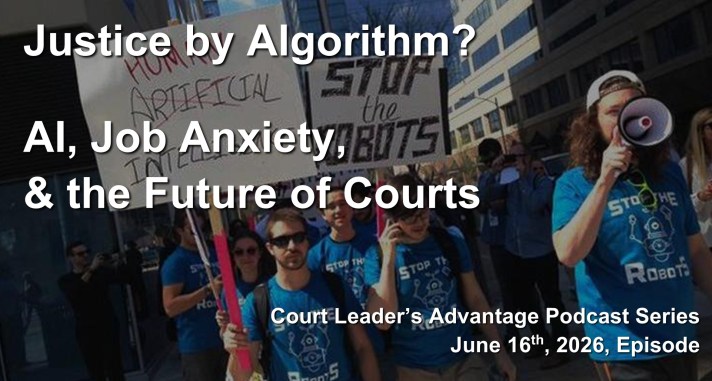
When former Google CEO Eric Schmidt, real estate executive Gloria Caulfield, and music executive Scott Borchetta praised artificial intelligence during recent commencement addresses, graduates responded not with applause but with boos.
For a growing number of Americans, especially younger workers entering the workforce, AI is no longer viewed primarily as a tool of innovation and opportunity. Rather, it is increasingly seen as a threat to jobs, economic security, and public trust.
The concerns are multifaceted. AI’s massive demand for electricity and water raises environmental questions. Its capacity to generate misinformation and “hallucinated” facts raises concerns about public trust and the integrity of information. Most significant for Generation Z, however, is the fear that AI will fundamentally alter the job market and undermine economic security.
Many technology leaders appear largely unmoved by these concerns. Sam Altman, CEO of OpenAI, has argued that fears of widespread job displacement are overstated. Jensen Huang, CEO of Nvidia, contends that workers will not lose jobs to AI itself, but rather to workers who know how to use AI more effectively. Jeff Bezos, founder of Amazon, has similarly predicted that AI will increase productivity, create new opportunities, and improve living standards rather than simply eliminate jobs.
The public remains unconvinced.
A March 2026 Quinnipiac University poll found that 70% of Americans believe AI will reduce the number of available jobs. Among Generation Z, concern is even more pronounced, with 81% believing advances in artificial intelligence are likely to decrease employment opportunities.
These concerns are fueled by highly visible workforce reductions. In 2025, Amazon announced approximately 14,000 corporate layoffs while acknowledging that AI-enabled efficiencies played at least a partial role in workforce reductions.[i] UPS announced plans to eliminate 20,000 positions. While the main reason for the reduction in force was a pullback by Amazon, CEO Carol Tomé also cited efficiencies from implementing AI.[ii] Cisco reduced its workforce by more than 4,000 employees while increasing its focus on AI-driven networking and security products.[iii] Whether AI was the sole cause of these decisions is debatable, but for many workers the message was unmistakable: artificial intelligence is increasingly associated with fewer jobs rather than greater opportunity.
Courts have historically been cautious adopters of new technology, and artificial intelligence appears to be no exception. Yet courts also face chronic staffing shortages, budget constraints, growing caseloads, and increasing pressure to improve efficiency. It may not be long before legislatures, funding authorities, and court leaders begin asking whether AI can help courts accomplish more with fewer resources.
[i] Variety, “Amazon Says It Will Lay Off 14,000 Corporate Workers, Citing AI” (October 31, 2025)
[ii] Gulf News, “AI Job Cuts: Major Companies Replacing Humans with Bots in 2025” (February 21, 2026)
[iii] PBS (October 28, 2025), “Despite reporting record quarterly revenue of $15.8 billion — up 12% year-over-year — Cisco announced layoffs representing less than 5% of its global workforce, as the company realigned around AI-driven growth”
Listen to the June 16, 2026, CLA Podcast Episode on your way to or from work, 29 Minutes 46 seconds. Be sure to share the link to this episode on your social media pages. It lets more people know about the important work of court administration in our community.
Watch the June 16, 2026, CLAPodcast Episode on YouTube, 31 Minutes 54 Seconds. Be sure to click on the subscribe button. It draws more attention to the topic of court administration on YouTube.
Today’s Panel

Karl Thoennes III began his career in the courts in Alaska in 1988, ultimately working as a division supervisor at the state’s largest trial court in Anchorage. He was appointed as Court Administrator in Todd County, Minnesota in 1998, and then Stearns County, St. Cloud, two years later. In 2004 he was appointed as Administrator for the Second Judicial Circuit in South Dakota, the state’s largest circuit by population.
For the past five years, together with Peter Kiefer, Karl has been the regular columnist on ethics in The Court Manager, a national publication for court leaders.
Karl has served as speaker or panelist on a number of state, regional, and national programs including conferences for the National Association for Court Management, the Mid-Atlantic Association for Court Management, and various other colleges, universities, and professional associations in Minnesota and South Dakota. Karl has guest lectured at St. Cloud State University on court structure and management, spoken on international public ethics in Minneapolis, and completed two graduate seminars in public policy in Sapporo, Japan, first as a student and then guest speaker. He holds a Master’s degree in public administration from the University of Alaska.

Creadell Webb is the Chief Diversity, Equity, and Inclusion (DEI) Officer for the First Judicial District of Pennsylvania (FJD). He is a highly experienced and accomplished professional with a proven track record of success in creating inclusive work environments.
Creadell held a variety of positions at the FJD, including judicial law clerk, manager, and deputy chief. In those roles, he demonstrated his ability to lead and motivate teams, draft legal documents, and manage complex projects. He is also a skilled trainer and educator who has conducted numerous Continuing Legal Education (CLE) and educational training programs on DEI.
Creadell earned a Bachelor of Business Administration degree from Howard University and a Juris Doctorate from The Catholic University of America, Columbus School of Law. He is licensed to practice law in Maryland, New Jersey, and Pennsylvania. Creadell is a Society for Human Resource Management (SHRM) certified professional and holds a “Diversity and Inclusion” certificate from Cornell University’s online program. He is passionate about creating a more just and equitable society. He is a strong advocate for equity in the court system, the legal world, and society.

Tracy “T.J.” BeMent is the District Court Administrator for the 10th Judicial Administrative District of Georgia. The 10th JAD covers the general jurisdiction Superior courts in six circuits in 21 counties. He was previously the Court Administrator for the Athens-Clarke County Courts in Athens, Georgia, where he worked with all six levels of trial courts in the county. He acts as the primary liaison to the state and county governments and serves as a resource for the judges and judicial staff on many issues.
T.J. administers nearly $2 million in state and federal grants and is a federal grant peer reviewer.
He has been working in the courts for more than 15 years. Prior to coming to Georgia, he was the Assistant Court Administrator for the Las Vegas Justice Court and previously the Clerk of Court and Chief Administrative Officer of the District of Columbia’s Office of Administrative Hearings. He received his undergraduate and graduate degrees from the George Washington University in Washington, DC, and completed his ICM Fellowship in spring 2015.

Rick Pierce is the Judicial Programs Administrator for the Judicial District Operations and Programs Department. he has served in the field of court administration for the past twenty-nine years. Prior to his appointment at the Administrative Office of Pennsylvania Courts, Rick was the district court administrator for Cumberland County. Prior to his 4 ½ year tenure as court administrator, Rick was the assistant administrator for the 9th judicial district from 1988-1997.
As judicial programs administrator, Rick is responsible for the implementation of programs and education in court administration at the general and limited jurisdiction court levels.
Rick served as the President for the Mid-Atlantic Association for Court Management for 2005-2006. Previously he has served on the MAACM advisory board from 1997-2005.
A graduate from Washington and Lee University, Rick received his Masters in Public Administration from Shippensburg University in 1995. He has been an active member of the Pennsylvania Association of Court Management, (PACM) since its inception in 1989. He has served as a board member from 1994-2001, culminating in his presidency in 2000-2001.
Do You Want To Know More?
AI Adoption Rising. So Why Is Gen Z Trust Declining?
Americans Oppose AI Data Centers in Their Area
From Indiana to Idaho, a Backlash Against A.I. Gathers Momentum
Gen Z Is Turning Against AI in an Incredible Way
Transcript
Transcript of the June 16th Court Leader’s Advantage Podcast Episode
Exciting News
The link to the Court Leader’s Advantage is now on Reddit! Be sure to access Reddit then go to r/CourtAdministration to see the link to the latest podcast episode.

 Court Leader