November 17th Court Leader’s Advantage 2026, Episode 109
Brought to You in Cooperation with the National Association for Court Management

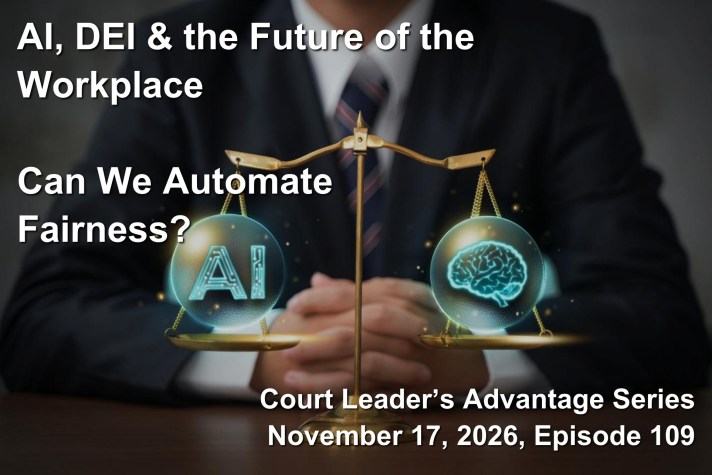
Artificial intelligence has the ability to advance diversity, equity, and inclusion, but it also has the ability to reproduce and amplify existing inequalities. The National Institute of Standards and Technology NIST, has identified several sources of AI bias.
These include historical and institutional inequalities, nonrepresentative training data, and human decisions in the design and use of algorithms. These biases can affect employment decisions ranging from résumé screening and candidate ranking to performance evaluations and promotions.
The central question is whether AI can make workplace decisions more fair or simply automate existing biases at greater speed and scale. AI can reduce some forms of human bias, but it does not guarantee impartiality or equitable outcomes. Employers must examine the quality and representativeness of their data, evaluate outcomes across demographic groups, provide appropriate accommodations, and maintain meaningful human oversight. For court leaders, the stakes are particularly significant: decisions about hiring, promotion, and workplace management must be consistent with the judiciary’s commitments to impartiality, due process, transparency, accountability, and equal access to justice.
This month, we are exploring how A.I. can affect the quest for fairness and impartiality in the work advancing diversity, equity, and inclusion in the courts.
Listen to the November 17, 2026, CLA Episode on your way to or from work. 28 Minutes 54 Seconds. Be sure to share the link to this episode on your social media pages. It lets more people know about the important work of court administration in our community.
Watch the November 17, 2026, CLA Episode on YouTube, 35 Minutes 26 Seconds. Be sure to click on the subscribe button. It draws more attention to the topic of court administration on YouTube.
Become Part of the Conversation
Send in your comments and questions to CLAPodcast@namnet.org
Today’s Panel

Stacey L. Fields is the Court Administrator for the City of Crestwood and has worked in the judiciary for 12 years. She has been a member of NACM for 5 years and serves on the Conference Development Committee.
Stacey also serves as Vice President of the Metropolitan St. Louis Association for Court Administration (MSLACA) and on the board of the Missouri Association for Court Administration as Professional Development Director.

Karl Thoennes III began his career in the courts in Alaska in 1988, ultimately working as a division supervisor at the state’s largest trial court in Anchorage. He was appointed as Court Administrator in Todd County, Minnesota in 1998, and then Stearns County, St. Cloud, two years later.
In 2004 he was appointed as Administrator for the Second Judicial Circuit in South Dakota, the state’s largest circuit by population.
For the past several years, together with Peter Kiefer, Karl has been a regular colntributor on ethics in The Court Manager, a national publication for court leaders.
Karl has served as speaker or panelist on a number of state, regional, and national programs including conferences for the National Association for Court Management, the Mid-Atlantic Association for Court Management, and various other colleges, universities, and professional associations in Minnesota and South Dakota. Karl has guest lectured at St. Cloud State University on court structure and management, spoken on international public ethics in Minneapolis, and completed two graduate seminars in public policy in Sapporo, Japan, first as a student and then guest speaker. He holds a Master’s degree in public administration from the University of Alaska.

Jorge Basto is the Director for IT Programs in the Cherokee County, Clerk of Court’s Office and oversees the implementation of new software programs and processes. Prior to joining the Clerk’s Office, Jorge served as Georgia’s Chief Information Officer for 15 years with the Judicial Council’s Administrative Office of the Courts (AOC).
Starting in 2005, he created the Judiciary’s first Information Technology Division standing up Development, Infrastructure, Reporting and Data Exchange services across the State. A champion of national standards, Jorge has served on the committees for the Organization for the Advancement of Structured Information Systems (OASIS), the Integrated Justice Information Systems (IJIS) and the Joint Technology Committee (JTC).
Jorge’s work led to large scale deployments of statewide solutions including the electronic filing of child support cases, digital transmissions of Georgia State Patrol Citations into the courts and Single Sign-On access to services for the State Bar, governmental agencies and the public. Leveraging public / private partnerships, he launched the first judicial marketplace (Gateway) that provides an array of services offered by state entities as well as private companies. Jorge is a Certified AWS Cloud Practitioner and fully migrated the entire AOC’s infrastructure to the cloud in 2019/2020.
A graduate of Georgia State University, Jorge has remained active in both local and national industry organizations and has been highlighted in the Gov Tech and ComputerWorld publications.
Do You Want To Know More?
The Role of Artificial Intelligence in Employee Recruitment
Exploring Perceptions of AI-Generated Job Advertisements
Ethics of AI-Enabled Recruiting and Selection
Transcript of the Episode
Transcript of the November 17th Court Leader’s Advantage Episode


