June 2nd, 2026, Question of Ethics: A Conversation on Courts and Ethics
Brought to You in Cooperation with the National Association for Court Management

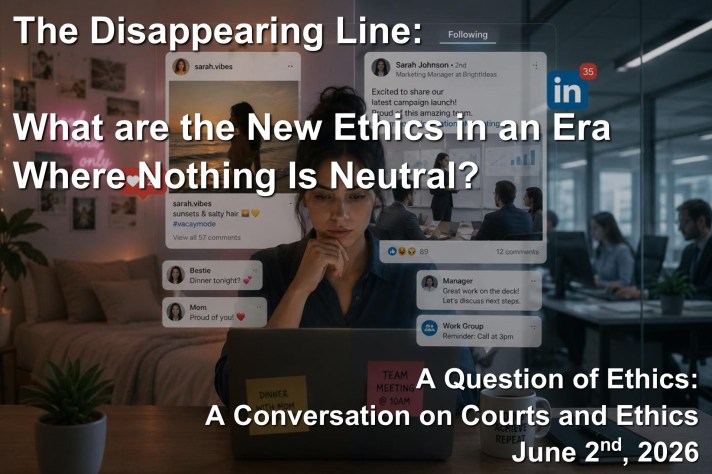
This episode of the Question of Ethics Conversation examines a fundamental ethical challenge facing court professionals today: how are their ethical responsibilities evolving in the age of social media with increasing politicization?
David Ozar, Cynthia Kelly, and Yvette Begue developed the original Code of Conduct for the American Judicature Society in 1989, which became the foundation for the NACM Model Code of Conduct for Court Professionals.
When they completed their seminal work, the boundary between political and nonpolitical activity was relatively clear. There was no social media; there wasn’t even much of an internet.
Canon Four of the Code focused on conduct that was unmistakably political: attending campaign rallies, canvassing for judges running for election, or advocating for ballot initiatives within the courthouse. At one point, we even debated whether it was appropriate for a court employee’s spouse to display a bumper sticker for a candidate.
The lines, while sometimes debated, were visible; today, those lines have all but disappeared. We now operate in a landscape where nearly every issue is viewed through a political lens. Statements that once would have been considered civic, educational, or banal are now often interpreted as partisan.
Canon Four reflects a world that presumes a meaningful distinction between one’s professional role and private life:
- A court professional engages in political activity strictly as a private citizen and only in accordance with Federal law, state law, local court rule, and policy of the appropriate local governing authority.
- A court professional participates in allowable political activity only during non–work hours, using only non-court resources.
- A court professional does not use his or her position or title within the court system to influence others.
- A court professional does not coerce or encourage other court staff to participate, or refrain from participating in political activity
At its core, Canon Four rests on a critical assumption: that court professionals can maintain a private sphere in which they exercise their First Amendment rights, separate from their official role. Nearly 40 years later, that assumption is severely strained.
In an era defined by social media and the always-on visibility of the digital world, personal expression is no longer private. Opinions, political or otherwise, are broadcast instantly, permanently, and often without context. Anonymity is fragile at best. Even attempts to separate identities through pseudonyms or multiple accounts are increasingly common and increasingly ineffective.
This episode does not claim to offer definitive answers. Instead, it confronts the complexity of the moment and frames questions that court professionals, and the profession itself, must now grapple with:
- Can we, as court professionals, realistically be held accountable for navigating an ever-expanding universe of “political” issues, even down to opinions about cultural events or entertainment?
- To what extent can we express our personal views without creating a perception of bias that undermines public trust?
- Do newer professionals fully understand that “private” social media activity can carry public consequences for the courts?
- Are courts at risk of becoming overly restrictive in regulating employees’ personal expression, or are such restrictions necessary to preserve legitimacy?
What emerges is not just an ethics question, but a question of professional survival and institutional trust. One possible path forward is not to attempt an ever-expanding list of prohibitions, but to shift toward practical, principle-based guidance. This could include developing best practices, strengthening commentary within the Code, and emphasizing leadership judgment, mentorship, and open dialogue.
Above all, the goal remains constant: to ensure that court professionals, regardless of personal beliefs, are perceived as fair, impartial, and worthy of the public’s trust. In a world where neutrality is harder to demonstrate, that responsibility has never been more important.
Listen to the June 2nd, 2026, Question of Ethics Episode on your way to or from work, 22 Minutes 42 Seconds. Be sure to share the link to this episode on your social media pages. It lets more people know about the important work of court administration in our community.
Watch the June 2nd, 2026, Question of Ethics Episode on YouTube, 23 Minutes 55 Seconds. Be sure to click on the subscribe button. It draws more attention to the topic of court administration on YouTube.
Today’s Panel
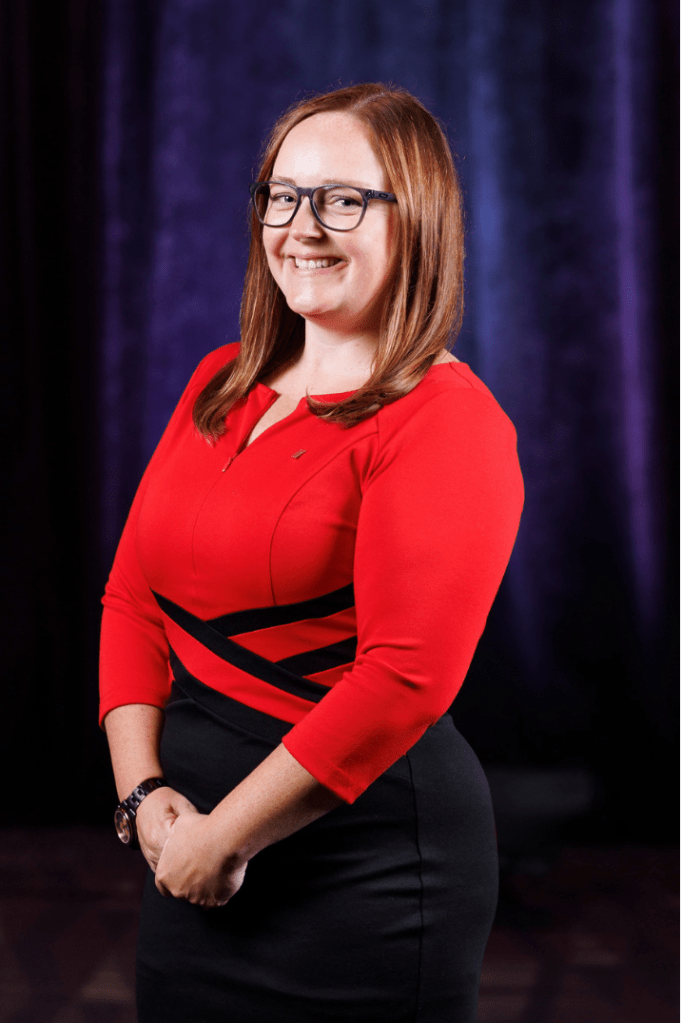
Kelly Hutton has worked for the North Dakota Court System since January 2007 and currently serves as the Deputy State Court Administrator. Throughout her career, Kelly has led and supported numerous projects to improve court operations in North Dakota.
Kelly joined the board of directors in 2019 and has served on various committees and has played a key role in the creation and rollout of the NACM CORE® Champion Program. In July 2025, Kelly was sworn in as President of NACM, where she is announced her priorities of increasing membership engagement, strengthening partnerships, and increasing community outreach and education.
Kelly teaches and presents nationally on topics such as caseflow management, accountability and court performance, workforce management, leadership, and operations management. She completed the ICM Court Management Program in 2015 and earned her ICM Fellowship from the National Center for State Courts (NCSC) in 2017. Kelly holds a B.A. in Legal Studies from Hamline University and a Master’s in Public Administration from the University of North Dakota, awarded in 2021.
Karl Thoennes began his career in the courts in Alaska in 1988, ultimately working as a division supervisor at the state’s largest trial court in Anchorage. He was appointed as Court Administrator in Todd County, Minnesota in 1998, and then Stearns County, St. Cloud, two years later. In 2004 he was appointed as Administrator for the Second Judicial Circuit in South Dakota, the state’s largest circuit by population.
Karl has served as speaker or panelist on a number of state, regional, and national programs including conferences for the National Association for Court Management, the Mid-Atlantic Association for Court Management, and various other colleges, universities, and professional associations in Minnesota and South Dakota. Karl has guest lectured at St. Cloud State University on court structure and management, spoken on international public ethics in Minneapolis, and completed two graduate seminars in public policy in Sapporo, Japan, first as a student and then guest speaker. He holds a Master’s degree in public administration from the University of Alaska.

Norman Meyer is a court administration expert after a 38 year career as a trial court administrator in the state and federal U.S. courts. Mr. Meyer has written and spoken widely on judicial administration in the United States and abroad, and is currently writing a court management blog (https://courtleader.net/vantage-point) as a member of the nonprofit Court Leader coalition. He is a member of the Advisory Council of the International Association for Court Administration (having previously served as Vice President for the North American region for five years), an Associate of the Justice Speakers Institute, a Past President and recipient of the Award of Merit of the National Association for Court Management, and has served on the Board of Directors of the National Center for State Courts.
Norman has experience working with many foreign judiciaries, especially in the Russian Federation, Serbia, Ukraine, Moldova, and Albania. He received his M.S. in Judicial Administration from the University of Denver Sturm College of Law in 1979, and a B.A. in political science and Russian studies from the University of New Mexico, graduating in 1977
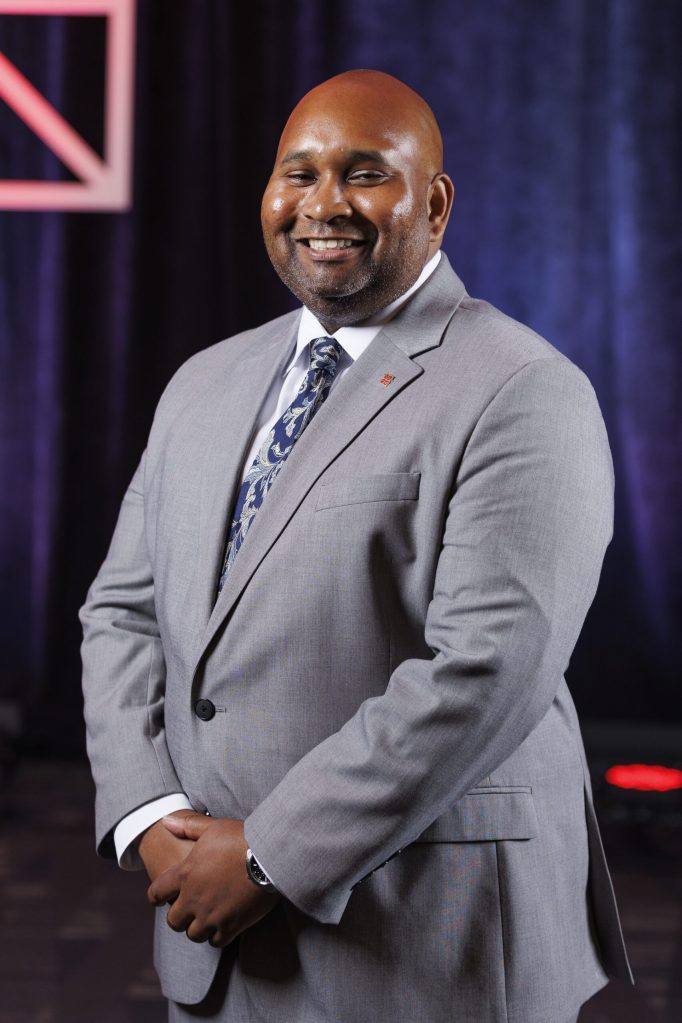
Creadell Webb is the Chief Diversity, Equity, and Inclusion (DEI)Officer for the First Judicial District of Pennsylvania (FJD). He is a highly experienced and accomplished professional with a proven track record of success in creating inclusive work environments.Creadell has held a variety of positions at the FJD, including judicial law clerk, manager, and deputy chief. In those roles, he demonstrated his ability to lead and motivate teams, draft legal documents, and manage complex projects.
He is also a skilled trainer and educator who has conducted numerous Continuing Legal Education (CLE) and educational training programs on DEI. Creadell earned a Bachelor of Business Administration degree from Howard University and a Juris Doctorate from The Catholic University of America, Columbus School of Law. He is licensed to practice law in Maryland, New Jersey, and Pennsylvania. Creadell is a Society for Human Resource Management (SHRM) certified professional and holds a “Diversity and Inclusion” certificate from Cornell University’s online program. He is passionate about creating a more just and equitable society. He is a strong advocate for equity in the court system, the legal world, and society.
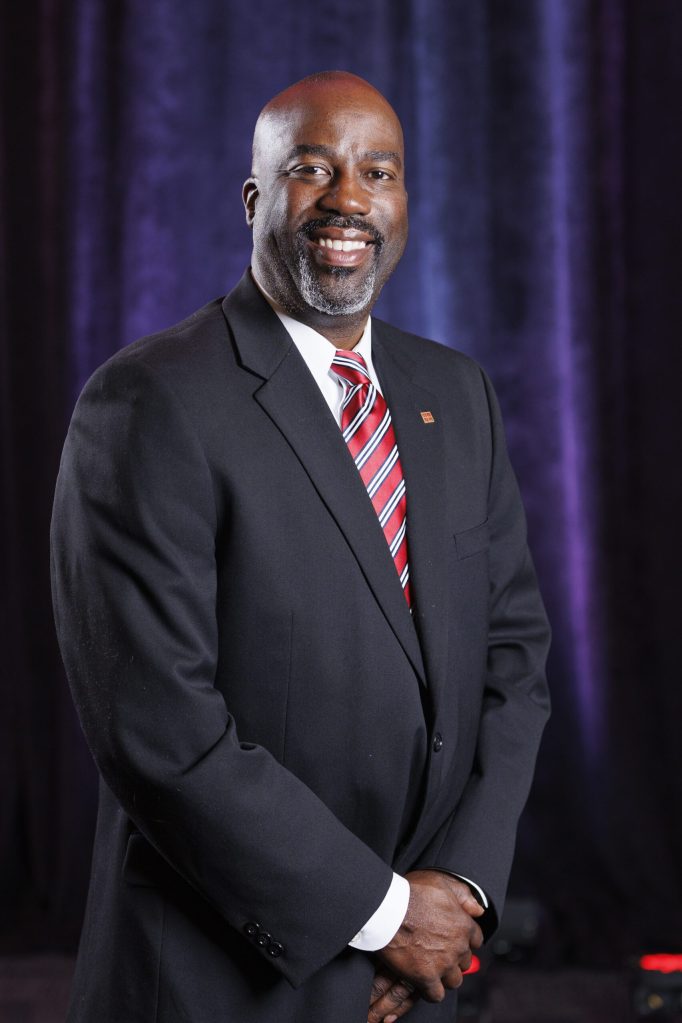
Nathaniel Mingo has been the Court Services Director for the City of Riverdale Municipal Court since 2006. Nate oversees the Clerk of Court, Probation Departments, and Court Administration in that capacity. Before that appointment, Nate served as court docket coordinator for the Fulton County Superior Court Clerks’ office. Nate is also active in his state association, where he has served as President and is currently serving the association as a board member.
Nate holds a B.A. in interdisciplinary studies with concentrations in law and sociology, and he has also obtained a Master’s Degree in Public Administration with a concentration in Management and Finance.

Teshrie Kalicharan serves as the Director of Alternative Dispute Resolution (ADR) for the Ninth Judicial Circuit of Florida, where she oversees the development and management of court-connected mediation services. In this role, Tess leads a team of mediators and ADR professionals who assist parties in resolving family, civil, and complex disputes, reducing case backlog and promoting efficient resolution. With years of experience in judicial administration and dispute resolution, Tess has introduced innovative practices to expand access to ADR, including digital mediation platforms, expanded training programs, and partnerships with community organizations. Her leadership reflects a commitment to equitable access to justice and strengthening public confidence in the courts.
Tess earned her Juris doctorate degree from Barry University School of Law. Graduated with an honors certificate in family law and was the Editor-in-Chief of the Barry Law School Child and Family Law Journal. She earned a Bachelor of Arts Degree in English Literature from St. John’s University. She is a certified county and family mediator and qualified arbitrator.


