July 21st, 2026, Court Leader’s Advantage Podcast, Episode 106
Brought to You in Cooperation with the National Association for Court Management

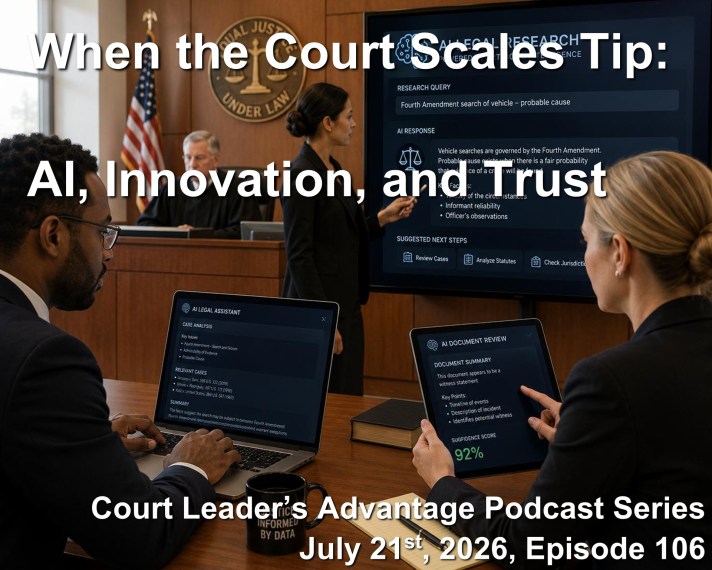
AI promises greater efficiency, lower costs, and better public service, but it also raises concerns about privacy, bias, job displacement, and accountability. This panel explores where courts should draw the line.
Artificial intelligence is currently having a difficult moment. Hardly a day goes by without headlines highlighting a new AI concern. Consider just a few of the issues currently dominating public conversation:
• Corporate leaders are investing billions in AI while simultaneously announcing layoffs, fueling fears about job displacement and economic insecurity.
• Communities across the country are opposing the construction of new data centers due to concerns about their massive consumption of water and electricity.
• Educators and researchers worry that AI has weakened students’ critical thinking and problem-solving skills by making information and answers available almost instantaneously.
• Privacy advocates warn that AI enables governments, employers, and corporations to monitor individuals more closely than ever before, raising concerns about the emergence of a surveillance society.
• Others fear that AI-generated videos, voices, images, and documents have become so convincing that distinguishing fact from fabrication is almost impossible. As a result, AI may undermine trust in elections, journalism, and public institutions.
These concerns are real and deserve careful consideration. Yet they often overshadow the remarkable accomplishments AI has already achieved. Consider just three examples:
• Google’s DeepMind developed an AI system that analyzes mammogram images that, in some cases, detect breast cancer earlier and more accurately than expert radiologists, reducing both false positive and false negative results.
• AI-powered wildfire detection systems now analyze live camera feeds, satellite imagery, weather data, and vegetation conditions to identify wildfire smoke within minutes. This saves valuable time for emergency first responders and ends up protecting lives and property.
• Arizona State University has implemented AI-powered educational tools that provide personalized learning experiences through conversational tutors, simulated learning environments, and on-demand academic support.
AI is also becoming increasingly embedded in court operations. It can summarize documents, draft reports, assist with legal research, identify patterns within large datasets, and automate a wide range of administrative tasks. Even courts that have not formally adopted AI are likely employing staff who are already experimenting with these tools in their day-to-day work. This reality raises a number of difficult questions.
As with many technological revolutions, the central challenge is not simply deciding what AI can do. The central challenge may be deciding what AI should do. How much responsibility should be delegated to algorithms? Where must human judgment remain indispensable? And how can courts strike the proper balance between innovation, efficiency, fairness, and accountability?
This month, we are continuing to explore the growing role of artificial intelligence in the courts. As always, our goal is not to provide definitive answers. Rather, to encourage thoughtful discussion about one of the most significant issues confronting the justice system today.
Listen to the July 21, 2026, CLA Podcast, Episode 106 on your way to or from work, 41 Minutes 51 seconds. Be sure to share the link to this episode on your social media pages. It lets more people know about the important work of court administration in our community.
Watch the July 21, 2026, CLAPodcast, Episode 106 on YouTube, 45 Minutes 12 Seconds. Be sure to click on the subscribe button. It draws more attention to the topic of court administration on YouTube.
Where should courts draw the line on AI? Email your comments or questions to CLAPodcast@nacmnet.org. Selected comments may be featured in a future episode.
Today’s Panel

Karl Thoennes III began his career in the courts in Alaska in 1988, ultimately working as a division supervisor at the state’s largest trial court in Anchorage. He was appointed as Court Administrator in Todd County, Minnesota in 1998, and then Stearns County, St. Cloud, two years later.
In 2004 he was appointed as Administrator for the Second Judicial Circuit in South Dakota, the state’s largest circuit by population.
For the past five years, together with Peter Kiefer, Karl has been the regular columnist on ethics in The Court Manager, a national publication for court leaders.
Karl has served as speaker or panelist on a number of state, regional, and national programs including conferences for the National Association for Court Management, the Mid-Atlantic Association for Court Management, and various other colleges, universities, and professional associations in Minnesota and South Dakota. Karl has guest lectured at St. Cloud State University on court structure and management, spoken on international public ethics in Minneapolis, and completed two graduate seminars in public policy in Sapporo, Japan, first as a student and then guest speaker. He holds a Master’s degree in public administration from the University of Alaska.

Creadell Webb is the Chief Diversity, Equity, and Inclusion (DEI) Officer for the First Judicial District of Pennsylvania (FJD). He is a highly experienced and accomplished professional with a proven track record of success in creating inclusive work environments.
Creadell held a variety of positions at the FJD, including judicial law clerk, manager, and deputy chief.
In those roles, he demonstrated his ability to lead and motivate teams, draft legal documents, and manage complex projects. He is also a skilled trainer and educator who has conducted numerous Continuing Legal Education (CLE) and educational training programs on DEI.
Creadell earned a Bachelor of Business Administration degree from Howard University and a Juris Doctorate from The Catholic University of America, Columbus School of Law. He is licensed to practice law in Maryland, New Jersey, and Pennsylvania. Creadell is a Society for Human Resource Management (SHRM) certified professional and holds a “Diversity and Inclusion” certificate from Cornell University’s online program. He is passionate about creating a more just and equitable society. He is a strong advocate for equity in the court system, the legal world, and society.

Tracy “T.J.” BeMent is the District Court Administrator for the 10th Judicial Administrative District of Georgia. The 10th JAD covers the general jurisdiction Superior courts in six circuits in 21 counties. He was previously the Court Administrator for the Athens-Clarke County Courts in Athens, Georgia, where he worked with all six levels of trial courts in the county.
He acts as the primary liaison to the state and county governments and serves as a resource for the judges and judicial staff on many issues.
T.J. administers nearly $2 million in state and federal grants and is a federal grant peer reviewer.
He has been working in the courts for more than 15 years. Prior to coming to Georgia, he was the Assistant Court Administrator for the Las Vegas Justice Court and previously the Clerk of Court and Chief Administrative Officer of the District of Columbia’s Office of Administrative Hearings. He received his undergraduate and graduate degrees from the George Washington University in Washington, DC, and completed his ICM Fellowship in spring 2015.

Rick Pierce is the Judicial Programs Administrator for the Judicial District Operations and Programs Department. he has served in the field of court administration for the past twenty-nine years.
Prior to his appointment at the Administrative Office of Pennsylvania Courts, Rick was the district court administrator for Cumberland County. Prior to his 4 ½ year tenure as court administrator, Rick was the assistant administrator for the 9th judicial district from 1988-1997.
As judicial programs administrator, Rick is responsible for the implementation of programs and education in court administration at the general and limited jurisdiction court levels.
Rick served as the President for the Mid-Atlantic Association for Court Management for 2005-2006. Previously he has served on the MAACM advisory board from 1997-2005.
A graduate from Washington and Lee University, Rick received his Masters in Public Administration from Shippensburg University in 1995. He has been an active member of the Pennsylvania Association of Court Management, (PACM) since its inception in 1989. He has served as a board member from 1994-2001, culminating in his presidency in 2000-2001.
Do You Want To Know More?
The New Pro Se_ Generative AI and the Surge in Federal Civil Self-Representation
The Inevitability of AI in Court_ What Does It Mean for Self-Represented Litigants_ – NSRLP
How courts are coping with a flood of AI-generated lawsuits _ MIT Technology Review
Confidentiality of AI Conversations
Transcript
Transcript of the July 21st Court Leader’s Advantage Podcast, Episode 106


