

When I started this blog I shared one of the best pieces of leadership advice I ever received: “The most important asset in any organization are people.”[i] Unfortunately, many leaders fail to follow through and properly manage staff across the entire employment cycle. Last month I read a particularly incisive Substack post about a key part of workforce management,[ii] employee retention: “Stop Throwing Money at Employees Who Have Already Decided to Leave,”[iii] by Abi Adamson.[iv] In this post Adamson applies her SERN™ workforce culture framework (Soil, Exposure, Roots, and Nutrients) to explain how leaders can do a much better job at workforce retention. With Abi’s permission, here is her post:
________________________________________________________
The moment good people start leaving, the reflexes kick in. Counteroffers. Retention bonuses. A hastily arranged chat about career pathing that should have happened a year ago. All of it aimed at one thing, stopping the person walking out the door.
None of it asks the only question that matters. Why did they want to leave in the first place?
The Numbers Nobody Wants to Own
In 2024, Gallup studied hundreds of people who had voluntarily quit their jobs. 42% said their manager or organization could have done something to keep them. Not with money. With attention, in the months before anyone was looking. Here is the part that should sting more: roughly half said that in their final three months, nobody in leadership asked a single meaningful question about how their job was going.
They did not leave quietly. They left unasked.
Gallup has also estimated that voluntary turnover costs US businesses around a trillion dollars a year, with replacing one employee running from half to twice their annual salary. Every preventable exit is money walking out the door with its badge still on.
The Wall or the Garden
Keeping people and being worth staying for are two completely different projects. One is about building a higher wall. The other is about growing something people would not think to climb over. Most companies pour everything into the wall and nothing into the thing behind it.
🍂 It is a soil problem. People stay rooted in ground that feels good to grow in. No bonus makes toxic soil worth staying in. It just delays the leaving and adds resentment to the wait.
☀️ It is an exposure problem. People stay where their work is seen and their future feels possible. A retention package cannot buy back years of being overlooked. It only reminds them how long the overlooking went on.
🌱 It is a roots problem. People stay for genuine connection, for feeling part of something. That cannot be manufactured in a panic once someone has already handed in their notice.
💦 It is a nutrients problem. People stay where they are still growing. If the growth stopped long ago, a raise just means being paid more to stand still.
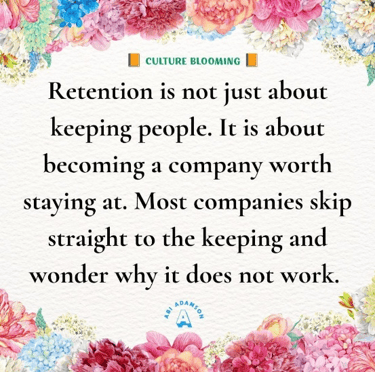
Retention is not just about keeping people. It is about becoming a company worth staying at. Most companies skip straight to the keeping and wonder why it does not work.
The Exit Interview Is the Wrong Interview
Here is the paragraph I wish every executive would print out. The exit interview is the most honest conversation most organizations ever have with their people, and it happens at the one moment the honesty can no longer help. Every answer given in that room was available months earlier, sitting in one-to-ones that got cancelled, surveys that got filed, corridor conversations that got smiled past. Your people have been telling you why they leave the whole time. The exit interview is not where the truth comes out. It is where the truth stops being useful.
💡 A counteroffer treats the symptom on the day it finally shows. Being worth staying for treats the cause, every day, long before anyone updates their CV. One is panic. The other is culture.
Here is what leaders learn too late. By the time you are making the counteroffer, you have already lost. The person sitting across from you did the emotional work of leaving months ago. Whatever you put on the table now, they will take it, stay a little longer, and leave anyway once the market turns.
You did not fix anything. You bought yourself a delay and called it a save.
Stop asking how to keep people. Start asking what would make them never seriously want to go. The answer to that is not a bonus. It is everything the bonus was trying to paper over.
______________________________________________
Wow, that’s powerful advice! Although it seems so obvious that we should do everything we can to make staff want to stay and contribute to the mission of the organization, too often this is not reality. For my court friends, go back re-read Adamson’s words and substitute “court” for “company” and think about your own workplace. How does it measure up?
Adamson’s advice really resonates with me. Earlier this year the NACM Court Manager journal published my article “Performance Previews, NOT Reviews!,”[i] and a key part of the article advocates what Adamson recommends. Managers should transform their performance management practices to be as much (or more!) forward looking than reviewing the past. There should be regular, substantive conversations with staff members to collaborate on how both can make things better in the future via regular discussions and individualized action plans.
I look forward to continuing to follow Adamson’s writings to learn more about improving organization culture and leadership.
[i] NACM – Court Manager Performance Previews, NOT Reviews!
[i] Legendary Leadership Advice – Court Leader
[ii] Workforce Management – National Association for Court Management
[iii] https://abiadamson.substack.com/p/the-counteroffer-came-too-late?r=9qq0t&utm_campaign=post&utm_medium=web
[iv] Abi is founder of The Culture Framework, author, and consultant – Home – Abi Adamson – Shaping Future Workplaces with Organizational Culture Expertise.


