September 1st, 2026, Question of Ethics: A Conversation on Courts and Ethics
Brought to You in Cooperation with the National Association for Court Management


Court professionals are committed to fairness, impartiality, and equal access, principles reflected in the NACM Model Code of Conduct. Yet many Americans believe the legal system operates on two tracks, one for those with financial resources and another for those without.
This perception extends from landlord-tenant cases to family law, debt collection, consumer disputes, and other civil matters. Wealthier parties can afford attorneys, expert witnesses, and other resources, while lower-income individuals must often navigate complicated legal procedures alone. Does this public perception of a “two-tiered” system of justice have merit? If so, can courts do more to counter this perception?
Courts cannot eliminate economic inequality; they can improve how people experience the justice system. Many courts have created self-service areas where self-represented litigants can come to learn about court procedures and become more familiar with how the court operates. On the other hand, self-service centers cannot advise litigants on how to present a case to a judge. Are self-service centers enough to “balance the scales”?
Frontline court staff play a particularly critical role because they are often the first, and sometimes only, court employees with whom litigants interact. Well-trained, empathetic staff can explain court procedures, provide legal information without giving legal advice, and help individuals feel heard and respected. These interactions significantly influence public trust and confidence in the courts.
Procedural fairness is of vital importance. Even when legal outcomes cannot be changed, litigants are more likely to view the process as fair if they understand what is happening, are treated respectfully, and have an opportunity to tell their story. Meeting the litigant’s “human need” to be seen and heard is just as important as meeting the “business need” of processing court paperwork efficiently. What more can courts do to address this serious need?
Should courts reach beyond courthouse walls? Rather than waiting for people to seek assistance, can courts partner with legal aid organizations, bar associations, libraries, schools, and community organizations to provide legal information where people live? Examples include legal clinics held in community centers, outreach at neighborhood events, informational booths at public festivals, and educational campaigns using local media and social media. These efforts can help reduce fear of the courts and increase awareness of available legal resources.
Technology offers additional opportunities but also raises concerns. Can artificial intelligence help self-represented litigants understand legal procedures and identify possible legal issues? However, current AI systems can also produce inaccurate information and may not recognize the nuances of individual cases. While many self-represented litigants are already using AI tools, courts are reluctant to recommend them until issues involving accuracy, unauthorized practice of law, and disclosure requirements are better resolved.
Mediation is another valuable tool for reducing power imbalances. By encouraging open communication in plain language rather than legal jargon, mediation allows both parties to be heard and often produces mutually acceptable solutions. Skilled mediators can help uncover issues that may never surface during formal courtroom proceedings and can help balance unequal bargaining power between parties. Should courts dedicate more resources to upgrading and extending mediation services to more case types?
Another promising model is the use of trained community justice workers or licensed legal paraprofessionals, as implemented in states such as Alaska and Arizona. These individuals are trained in specific areas of law, work through nonprofit organizations rather than the courts, and help underserved populations navigate the legal system. Could such programs have significant potential, particularly in rural communities with few attorneys, provided appropriate safeguards maintain court neutrality?
Should wealthier individuals be limited because they can afford excellent legal representation? The goal of courts is not to diminish quality representation for some but to ensure that everyone else has a meaningful opportunity to participate in the justice system. Should courts focus on creating fair processes, improving access to legal information, expanding community partnerships, and promoting equitable participation?
Courts cannot solve society’s broader economic inequalities; they can significantly strengthen public trust by making court processes more understandable, accessible, respectful, and equitable. Eliminating disparities in access to justice should become as central to court administration as the longstanding commitment that “justice delayed is justice denied.”
Listen to the September 1st, 2026, Question of Ethics Episode on your way to or from work, 39 Minutes 20 Seconds. Be sure to share the link to this episode on your social media pages. It lets more people know about the important work of court administration in our community.
Watch the September 1st, 2026, Question of Ethics Episode on YouTube, 42 Minutes 6 Seconds. Be sure to click on the subscribe button. It draws more attention to the topic of court administration on YouTube.
Today’s Panel

Rick Pierce is the retired Judicial Programs Administrator for the Judicial District Operations and Programs Department. he has served in the field of court administration for the past twenty-nine years. Prior to his appointment at the Administrative Office of Pennsylvania Courts, Rick was the district court administrator for Cumberland County.
Prior to his 4 ½ year tenure as court administrator, Rick was the assistant administrator for the 9th judicial district from 1988-1997.
As judicial programs administrator, Rick is responsible for the implementation of programs and education in court administration at the general and limited jurisdiction court levels.
Rick served as the President for the Mid-Atlantic Association for Court Management for 2005-2006. Previously, he served on the MAACM advisory board from 1997-2005.
A graduate from Washington and Lee University, Rick received his Masters in Public Administration from Shippensburg University in 1995. He has been an active member of the Pennsylvania Association of Court Management, (PACM) since its inception in 1989. He has served as a board member from 1994-2001, culminating in his presidency in 2000-2001.

Norman Meyer is a court administration expert after a 38 year career as a trial court administrator in the state and federal U.S. courts. Mr. Meyer has written and spoken widely on judicial administration in the United States and abroad, and is currently writing a court management blog (https://courtleader.net/vantage-point) as a member of the nonprofit Court Leader coalition.
He is a member of the Advisory Council of the International Association for Court Administration (having previously served as Vice President for the North American region for five years), an Associate of the Justice Speakers Institute, a Past President and recipient of the Award of Merit of the National Association for Court Management, and has served on the Board of Directors of the National Center for State Courts.
Norman has experience working with many foreign judiciaries, especially in the Russian Federation, Serbia, Ukraine, Moldova, and Albania. He received his M.S. in Judicial Administration from the University of Denver Sturm College of Law in 1979, and a B.A. in political science and Russian studies from the University of New Mexico, graduating in 1977.

Kaylee Jensen is a fourth year student at Santa Clara University studying Political Science with minors in Economics and International Business. She is an aspiring public servant who is dedicated to driving equitable systemic change.
She currently serves as a Research Assistant for at SCU Unhoused Initiative and a Government Ethics Fellow at the SCU Markkula Center for Applied Ethics.

Erica M. Payne-Santiago has dedicated over 25 years to public administration, serving within the nonprofit sector and the judiciary. Since 2016, she has been serving as the Deputy Court Administrator and Jury Commissioner for the Circuit Court of Prince George’s County. In this capacity, she has consistently demonstrated modernized leadership, introduced innovative technological advancements, and spearheaded forward-thinking initiatives to enhance court operations.
Over the past decade within the Court System, she is unwavering in her commitment to ensure that every courthouse visitor receives the highest standard of customer service and is treated with the utmost dignity and respect. Furthermore, she is dedicated to making justice accessible to everyone through meticulous case management operations and by maintaining a safe and thriving environment for all courthouse employees and visitors.
Erica is a dedicated public servant, demonstrating a profound commitment to the advancement of both the courts and the community. In 2024, She was recognized for her outstanding leadership and dedication as part of the Conference Development Committee, having been an active member of the National Association of Court Management (NACM) for over a decade. Consequently, she takes great pride in recently being sworn in as a new member of the 2025 NACM Board of Director, where she will serve as Co-Chair of the Communications Committee. Additionally, she is a member of the Maryland Mid-Atlantic Association for Court Management (MAACM). Through her involvement with the Administrative Office of the Courts (AOC), she plays a pivotal role in assessing and advancing court operations across the State of Maryland by serving on a variety of committees. Moreover, Erica has been serving as the elected President of the Homeowners Association Board (HOA) in Clinton, Maryland, for three years, including her current term from 2022 to 2025.
Prior to her extensive involvement in Court Administration, Erica worked with several non-profit agencies leading and managing programs that supported women, girls, at-risk youth, and Fortune 500 company board governance. She holds a Bachelor of Science in Social Work from Bowie State University and is a proud graduate of the District of Columbia Superior Court Management Training Program in which she earned a Certificate in Management/Leadership. Erica is achieving her master’s degree while simultaneously becoming a Certified Public Manager (CPM) from the prestigious University of Baltimore in Public Administration, which program is amongst the top 25% in the Country.

Devin Kuntz is a Montana public servant whose career spans forensic investigations, child protection, and court administration. He began as a forensic interviewer and Guardian ad Litem before supervising child protection specialists with the Montana Department of Public Health and Human Services. .
He has served as the District Court Administrator for Montana’s 11th Judicial District for nearly eight years. He is the author of Governing the Grind: A Leader’s System for Efficient Operations and Stakeholder Mastery. Devin lives in Kalispell, Montana with his wife and two children
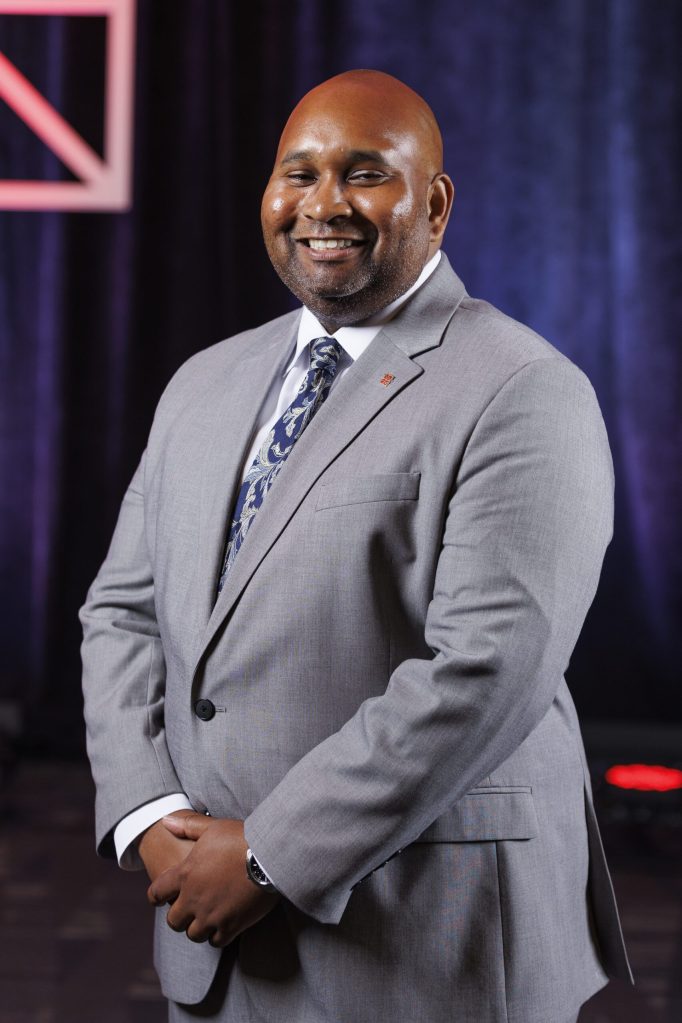
Creadell Webb is the Chief Diversity, Equity, and Inclusion (DEI) Officer for the First Judicial District of Pennsylvania (FJD). He is a highly experienced and accomplished professional with a proven track record of success in creating inclusive work environments.
Creadell has held a variety of positions at the FJD, including judicial law clerk, manager, and deputy chief. In those roles, he demonstrated his ability to lead and motivate teams, draft legal documents, and manage complex projects. He is also a skilled trainer and educator who has conducted numerous Continuing Legal Education (CLE) and educational training programs on DEI.
Creadell earned a Bachelor of Business Administration degree from Howard University and a Juris Doctorate from The Catholic University of America, Columbus School of Law. He is licensed to practice law in Maryland, New Jersey, and Pennsylvania. Mr. Webb is a Society for Human Resource Management (SHRM) certified professional and holds a “Diversity and Inclusion” certificate from Cornell University’s online program. He is passionate about creating a more just and equitable society. He is a strong advocate for equity in the court system, the legal world, and society.
Do You Want to Know More?
Producing Justice in Poor People’s Court
The Justice Gap: Confronting Complicity in the Legal Profession to Better Reimagine Reform
How to Measure and Address Disparities in Court Experiences and Outcomes _ The Pew Charitable Trusts
Undercutting Justice: Why Legal Representation Should Not Be Allocated by the Market
How Rising Income Inequality Threatens the Justice System
Criminal Justice Disparities Chart

 Court Leader