
On October 21 the World Justice Project (WJP) released its 2026 Rule of Law Index, the latest in its annual series of reports measuring people’s perceptions and experiences of the rule of law around the world.[i] As usual, the report is a valuable resource to understand the status and long-term trends of the rule of law by presenting detailed data on 44 variables for 143 countries. Readers of this blog may recall that because of the importance of the rule of law this is the fifth year of posts about the WJP’s reports.[ii]
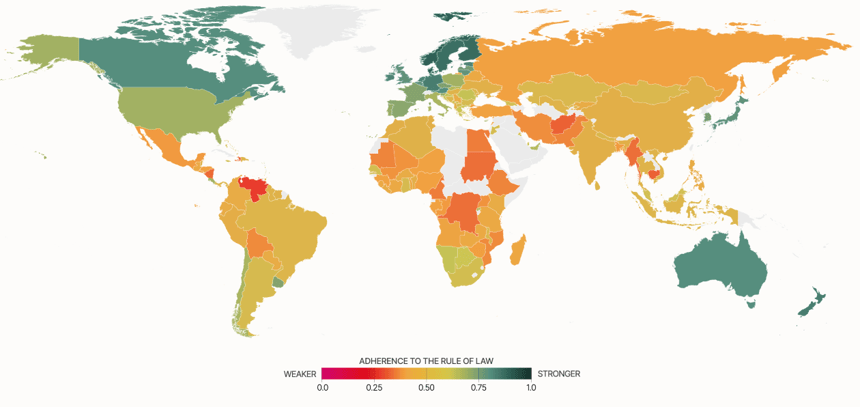
The current status of the rule of law around the globe is shown in this graphic (green is good, red is bad):
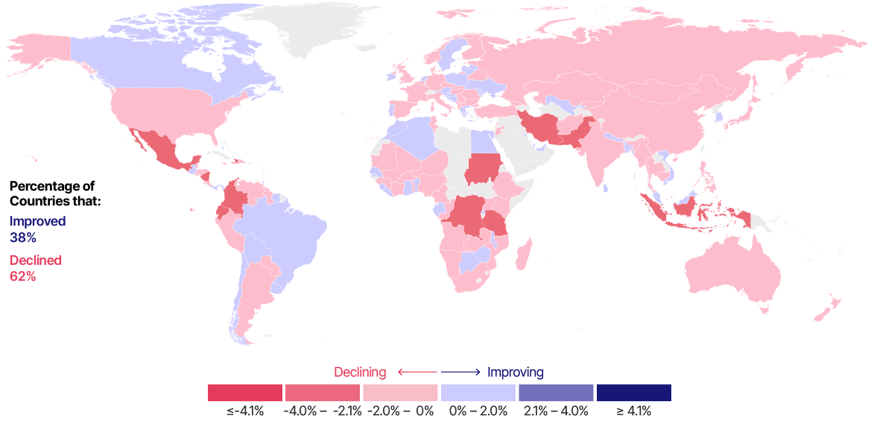
The 2026 WJP report shows that in the last year the rule of law declined in 62% of the countries surveyed, compared to a 68% decline in the prior year. While fewer countries declined this year compared to last, the global balance remains deeply uneven, with declines continuing to outnumber improvements for the ninth consecutive year.
- Top-Ranked Countries: Denmark (1), Norway (2), Finland (3), Sweden (4), New Zealand (5).
- Bottom-Ranked Countries: Venezuela (143), Afghanistan (142), Cambodia (141), Haiti (140), Nicaragua (139).
- Top Decliners: The most significant decliners include the Russian Federation (-4.9%), Sudan (-4.4%), and Mozambique (-3.9%).
- Top Improvers: Countries with the largest improvements include the Dominican Republic (2.1%), Senegal (1.6%), and Sierra Leone (1.4%).
An expansion of authoritarian practices — namely a constriction of civic space and weakening of checks and balances — remains the primary force behind this downturn:
- Declines in Constraints on Government Powers were driven by deteriorations in non-governmental checks, limits by the judiciary, and lawful transitions of power.
- Restrictions in Open Government were caused by rollbacks in civic participation and the right to information.
- Fundamental Rights deteriorated amid mounting restrictions on freedoms of speech, assembly, and association.
Freedoms essential to civic space, public debate, and government oversight are shrinking across most countries:
- Freedom of opinion and expression fell in 64% of countries.
- Freedom of assembly and association fell in 67%.
- Civic participation fell in 65%.
Although these declines are extremely troubling, in recent months the expansion of authoritarian practices has been tempered by elections in several countries. Voters in Hungary, Serbia, Brazil, Israel, and the United States have made turns towards more democratic leaders.
When I investigated how my country, the United States, performed in the WJP ratings I was (again) disappointed because the U.S. is one of the countries whose rating declined.[i] The U.S. global ranking also slipped three spots and is now 30th out of 143 countries (Denmark remained in first place). I encourage you to look up your own country to see how it is doing overall and in each of the assessment factor areas. The level of detail is quite illuminating.
Once again, the WJP report has made me think about what actions I might take to improve the rule of law. In my 2023 blog post about the WJP’s work, I ended with a call to action. Since we still are not doing well, here it is again:
After familiarizing yourself with your nation’s situation, I encourage you to join me in committing to taking action to support the Rule of Law locally. If you are in a nation that is already doing well, the goal is to keep that high ranking (although there are undoubtedly some areas that can be improved). If your nation is lower down in the rankings, focus on the factors that need improvement. What actions can you and your organization do to improve the Rule of Law? The phrase, “think globally, act locally” comes to mind.
A great way to take action is to apply court performance standards:
- The International Framework for Court Excellence is a great resource: Court Excellence
- In the United States, Courtools from the National Center for State Courts is a great resource:
- Trial courts: Trial Court Performance Measures | Courtools
- Appellate courts: Appellate Court Performance Measures | Courtools
As with most efforts, start small and concentrate on one or two areas for improvement. Then, build on that success and expand to other areas.
Another way to take action is to join and participate in court administration associations to stay informed and network with other court professionals. By seeing and understanding what others are doing, you will gain insights into current methods to improve; who knows, you may be able to share your court’s best practices with your peers. If you are not already a member, consider:
- The International Association for Court Administration (IACA): Home (iaca.ws). IACA has a great list of national and regional resources.
- The National Association for Court Management (NACM): National Association for Court Management – Strengthening Court Professionals (nacmnet.org). NACM has a wide range of publications and resources.
Finally, the World Justice Project has wonderful resources, such as its program library (reference sources, videos, slide decks) and engagement opportunities.
All of us involved in judicial administration have a responsibility to achieve excellence in our work to fulfill the public’s trust in us as public servants. Doing our best to achieve the highest level of the rule of law goes a long way to making that happen. I urge everyone to make supporting the rule of law a primary professional goal. The world will be a better place if you do.
[i] WJP Rule of Law Index | United States Insights
[i] World Justice Project | Advancing the rule of law worldwide
[ii] The Rule of Law, Index, and You – Court Leader defined the rule of law and included details about the WJP’s work and methodology as well as its 2022 findings; Rule of Law Index – 2023 Update – Court Leader; Demystifying and Measuring the Rule of Law – Court Leader reported on 2024 findings; and 2025 WJP Rule of Law Index – Court Leader.


